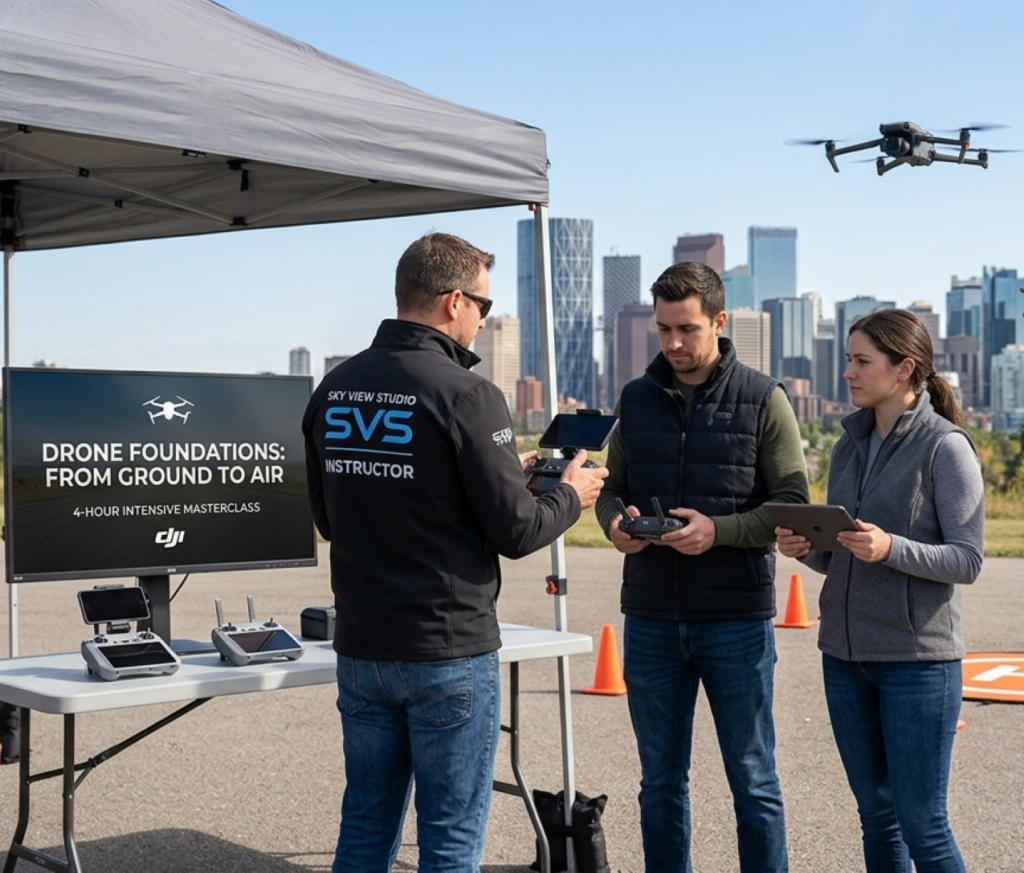
This intensive course is designed to teach you how to fly your RPAS (drone) safetly. Whether you are operating a compact DJI Mini or a robust industrial Industrial Matrice, this course provides a high-impact blend of critical theory and hands-on flight experience.
What Will You Learn?
You will start from the very beginning to master the art of flying your Remotely Piloted Aircraft System (RPAS) with professional-grade safety and precision. This course is designed to take you from unboxing your aircraft to executing complex flight patterns with confidence.
How much time do I need ?
This is a 4-hour intensive course designed to provide you with the essential knowledge and skills needed to perform secure, confident, and precise maneuvers. We’re a local professional RPAS School to build your foundation from day one.
Who this Course is for?
- New Owners & Hobbyists: If you just got your first drone and want to ensure your first flight isn’t your last, this is for you
- Any Proessionals: Construction teams looking for fast-track introduction to using RPAS for site walkthroughs real state or basic visual data
- Safety-concious Beginners: Anyone who wants to understant the “why and how” of drone laws, telemetry and airspace before they ever hit throttle
- Aspiring Commercial Pilots: A perfect “first step” for those planning to eventually pursue their Advance License or specialized industrial training
Start your Journey from the ground academy
Stop guessing and start flying with confidence
Inquire bellow for more details
Module 1: The Digital Cockpit
DJI Ecosystem Overview: Navigating the interface differences between consumer apps (DJI Fly) and enterprise software (DJI Pilot 2) how to use the app on your phone or native RPA Control
Module 2: Telemetry & Reading the Data
The Status Bar: Understanding GNSS signal strength, RC link status, and interference warnings.
Battery Intelligence: Calculating “Time to Home” vs. total flight time and monitoring cell health.
The Attitude Indicator: Learning to read the drone’s orientation, pitch, and yaw relative to the pilot in real-time
Sensor reach: Some RPA models include specific sensor functions, we will review in detail this safety measures
Module 3: Flight Planning & Safety
Pre-flight Intelligence: Checking Geo-Zones, Not all drones include this safety feature and not all geo zones means that you’re allowed to fly in.
Safety Buffers: Setting smart Return-to-Home (RTH) altitudes and obstacle avoidance parameters (APAS)
Mission Logic: Brief introduction to automated waypoints and grid mapping for industrial sites.
Safety options: before taking off we make sure to teach you how to set autonomous safety features
Module 4: The Aerial Lens & Intelligent Flight
Understanding Flight Modes (C, N, S): Understand when and we’re this flight modes are helpful for your daily captures
Intelligent “QuickShots” & Maneuvers: sometimes you can rely on these flight modes, is not all about your own skills when automation is there.
Cruise Control: yes, some drones has this function and we will teach you all the benefits and issues
Module 5: Mission Launch & Line-of-Sight
(The "Active Pilot" Phase)
Defining the Landing Zone (LZ): Establishing a “Clear Zone” (3-5 meter radius) free of debris, people, and overhead obstacles.
Maintaining VLOS (Visual Line of Sight):How to work with a Visual Observer to ensure the aircraft stays clear of hazards outside the pilot’s immediate view.
Managing “Ground Effect”: Understanding the air turbulence created by the drone’s own propellers as it nears the ground.
The “Clean Cut”: Procedures for disarming motors immediately upon touchdown to prevent tip-overs
Module 6: FAQ - Course dynamic
We will review and solve all questions during all modules
Theory-Practice Course – Modules 1/4 – 1.5 Hrs
Practices time – Modules 5 – 2.5 Hrs
We develop the course around your own drone
Are these courses industry-recognized?
Absolutely. We have over 10+ years of experience conducting drone operations and flight training globally.
We are fully registered with the Canadian Government (OC2518701402)
Vetted provider on the Transport Canada website.
And Compliant with ISO 23665:2023 Unmanned aircraft systems — Training for personnel involved in UAS operations canada
Will I receive a certificate upon completion?
Upon successfully finishing our course , you’re elegible for a Recognition from us.
That could serve as official proof that you have met our rigorous instructional standards & knowledge in our course fields. (please inquire for one if you are required to comply as proof of completition)
Please note that while we could provide a training certificate, and mission-readiness knowledge, the formal Pilot Certificate (License) is issued exclusively by Transport Canada following the successful completion of their regulatory requirements.
Disclaimer: This Course & training certificate is not an specialized training in any kind, and is not a prerequisite for any TC test or job positions. this course provides a Basic understanding of an RPAS system
Do you provide specialized industrial drone solutions?
Yes. We offer high-precision industrial solutions across
various sectors, including
* Thermal Imaging
* Advanced Surveillance
* Structural Inspection.
And more! As Advanced-Complex Operators, we don’t just capture footage; we provide specialized aerial data for critical infrastructure, agriculture, and security. Our team leverages state-of-the-art RPAS technology to deliver accurate, compliant, and safe results in even the most challenging environments, we follow the ISO 21384-3:2023 Unmanned aircraft systems. Operational procedures
Let’s Talk, Inquire below for more information
Do I need a Visual Observer anytime I fly my drone?
Short answer is No, only certain activities like:
* FPV (First-Person View) Flying
* EVLOS (Extended Visual Line of Sight)
you’ll need a certified VO, If you’re a Solo PIC – Pilot in command, be aware of keeping your drone in VLS – Visual Line of Sight at All times
We’re excited to have you!
Please complete your payment to get started
Need more info? Let’s connect.